
Chapter2
Young Adulthood
At “Buffet”
Jakusui: After graduating from the university, what kind of company did you join?
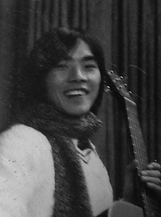
Priest Danjo: Actually, the year after I graduated, something utterly unexpected happened instead of getting a job in Japan, I ended up going to America. I was in a music band at the time and entered a nationwide contest. I didn't enter it because I wanted to become a professional musician; I was just after the prize money.
We recorded our original music on tape, passed the Kyoto screening, then the Kansai regional screening, and made it to the Tokyo finals. And among the thirteen bands that made it to the finals, we actually won the top prize.
It was my first time riding the Shinkansen. Originally a four-piece band, we suddenly became nine people since we could go to Tokyo. We all went to Tokyo together, full of excitement, to participate in the contest. There were famous people among the judges, and we were incredibly happy to receive the award.
But when we boarded the Shinkansen back home, we realized, “Hey, where'd the trophy and certificate we just got go?” “Huh, nobody's got them.” We'd left the trophy behind at the venue. It was that we were completely without ambition, and we weren't fixated on results. We just thought, “Isn't it great that we got to play the music we love?”
The Shinkansen we took was the last train of the day, stopping at every station like today's Kodama trains. Back then, Shinkansen had a “buffet” car where you could get food and drinks, so even late at night, you could at least get tea.
While all my bandmates were asleep, I was thirsty, so I went into the buffet car, sat down at a two-seater table, and drank coffee. Just then, a foreigner came in and sat down across from me.
I had experienced the Osaka Expo when I was in junior high, so whenever I saw a foreigner, I just wanted to speak in English. I called out, “Hello!” and tried my best to say, “My name is Kenji. I'm a university student living in Kyoto.”
He responded with a big smile, so I was happy to have myself understood in English. Then he asked, “What did you go to Tokyo for?” I answered, “I'm in a band, so I participated in a music contest in Tokyo and won the top prize.” He got really excited and said, “I'm into music too!” When I got his business card, I was surprised to find out he was the director of the cultural center inside the U.S. Embassy.
He was the top intermediary bringing top-tier musicians from the U.S. to perform at the embassy, introducing their amazing music across Japan. He was heading to Kyoto to prepare for opening a new American Cultural Center office there.
He suggested, “If you can play guitar, bring it and let's jam!” So I woke up the sleeping members, and we made a racket singing and playing guitar on the Shinkansen. When we got off the train, on a whim, I told him, “I have a car, so if you and your wife come to Kyoto next time, I'll show you around Kyoto.”
A few days later, he and his wife actually came to Kyoto, so I went to pick them up at the meeting spot. Looking back, I was amazed they got into my beat-up little kei car. Luckily, I kept it well-maintained, so it was fine. His wife was a lovely woman. As we parted after a day of sightseeing together, he invited me, “So, Kenji, why don't you come visit my apartment at the embassy sometime?”
Three months later, I decided to go to Tokyo. Since I had no money, I planned to hitchhike. On the Meishin Expressway, I stood near the interchange toll booth where trucks entered, holding a sign that said, “I'm going to Tokyo. Please give me a ride.” A truck driver saw me – I had long hair and looked like a student – and said, “Sure, hop in,” giving me a ride all the way to Tokyo.
That's how I managed to visit the embassy apartment in Roppongi. He welcomed me warmly, but when he asked, “How did you get to Tokyo?” and I replied, “I hitchhiked,” he was surprised and said, “Well done!” with admiration. So, I stayed at his place for about a week. He himself was a devout Jew, so I tried ‘Jewish bread’ for the first time at breakfast – round, doughnut-like – and it was delicious.
He was an exceptionally talented man, well-educated in many fields, with great musical ability. He'd even released records in the United States. He had many American friends in Japan too, and during my stay, he took me to various places. The most surprising was the grocery store inside the U.S. Embassy. There, they sold fruits, meats, and other foods I'd never seen in Japan, priced in dollars, and it was incredibly cheap.
When he asked me, “What do you want to do after graduation?”, I said, “Actually, I want to go to California in the United States.” The reason was that California music was popular in Japan at the time. There were bands like the Eagles, the Doobie Brothers, and many others. My goal was simple: I just wanted to hear authentic, live music.
He then asked, “Kenji, what kind of studies do you want to pursue?” I replied, “I'm thinking of studying agricultural economics.” I thought if he had connections like that, I'd love to study abroad, but I didn't think it was possible since my English wasn't that good.
But then, he said, “Well, then, University B in California might be a good fit.” He suggested, “I know a dentist there who could let you stay with him, and you could do the studies you want to once you get there.”
Back then, I didn't know that university was a world-renowned institution, so I casually replied, “Yes, please.” This was before the internet. He, also a university professor, wrote letters to his academic contacts recommending me. He told me, “Kenji, I'll make sure you can go to a university, so, when the letters arrive, get ready immediately and to go to America.”